AI in Developing Economies: Automation Risk Is Three Times Lower, the Upside Almost the Same
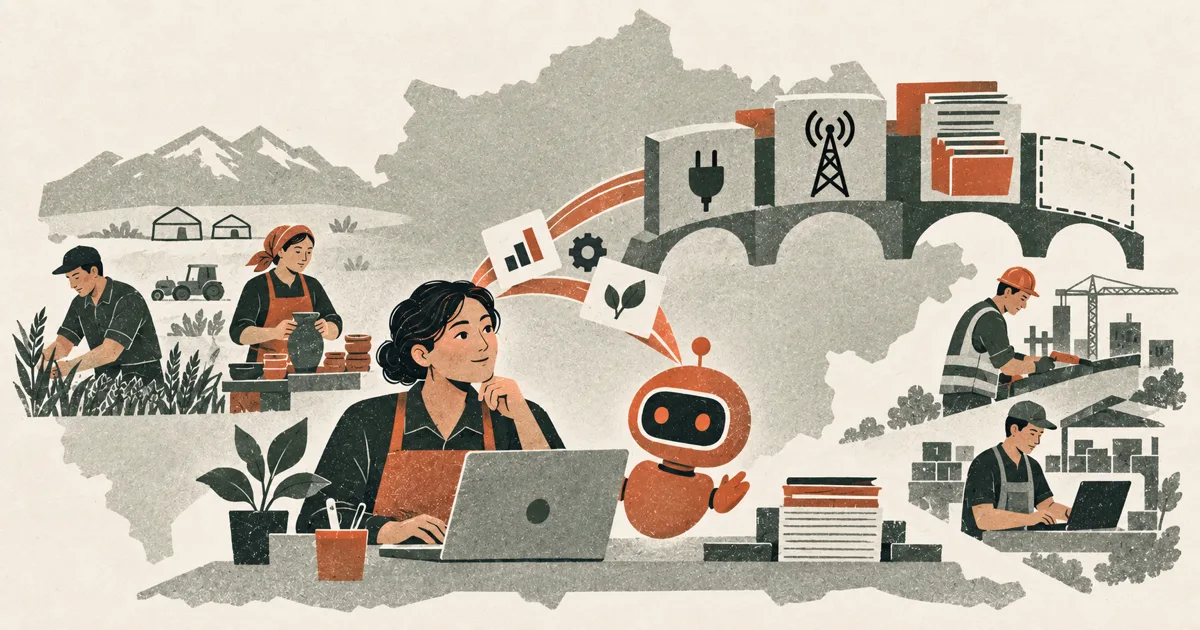
According to the World Bank, 4.5% of jobs in low- and middle-income countries are at risk of automation, against 14.2% in high-income countries. The potential productivity gain is almost equal. What this means for Kazakhstan.
Almost all research on how AI affects work has been done in the US. Its conclusions cannot be carried over to Kazakhstan directly: the structure of employment is different, the industries are different, the share of computer-based work is different. In 2026 two sources appeared that give a frame for developing economies.
The World Bank report
In August 2026 the World Bank released its World Development Report, The Promise of Artificial Intelligence. The main figures from the accompanying press release are as follows.
| Indicator | Low- and middle-income countries | High-income countries |
|---|---|---|
| Jobs at risk of automation by generative AI | 4.5% | 14.2% |
| Jobs where a meaningful productivity gain is possible | 16.2% | 18.7% |
The risk differs by a factor of three. The potential gain is almost the same.
The Bank adds a caveat at once: the gain is not guaranteed. Capturing it takes reliable electricity and connectivity, skills, access to computing power, and data in local languages.
This is an estimate of how closely the tasks of occupations match what AI can do. The report does not count jobs lost.
The ILO and World Bank study
A background study for the report, Disruption without dividend?, was published in March 2026. It covers 135 countries, around two thirds of global employment, and explains where the difference comes from.
- •Exposure to generative AI is higher in advanced economies, particularly in clerical and professional occupations.
- •In lower-income economies, workers perform fewer non-routine analytical tasks and rely less on computers at work.
- •Those who could gain in productivity often lack reliable internet access.
- •Clerical work in poorer countries offers relatively good jobs and has been a traditional path to decent employment for women and young people. It is also the work most exposed to AI.
Hence the title of the study: disruption may arrive without the dividend if the digital divide remains.
What is known about Kazakhstan
The World Bank press release gives no separate figures for Kazakhstan. There are two local reference points.
In 2023 the Center for Workforce Development estimated that 29% of work functions in the country could be automated with high or moderate probability, and that 13% could be performed by generative AI. The estimate predates AI agents and covers the whole economy.
According to the Bureau of National Statistics, 3.4% of the enterprises that reported on ICT use applied artificial intelligence in 2025. More on this in the article "AI Accountant in 2026".
What follows from this
What comes next is our own judgment; the reports themselves draw no such conclusion.
Kazakhstan belongs to the group of middle-income countries. If the World Bank's frame holds for this group, pressure on jobs here is weaker and will arrive later than in the US studies. The window for productivity growth is comparable.
Within the country the picture is uneven. Finance, law, accounting and other professional services consist of analytical work at a computer, and for them exposure is above the national average.
For a company this means three things.
- 1There is more time to prepare than American headlines suggest. It is best spent on people's skills.
- 2The condition for capturing the gain, according to the Bank, is data and connectivity. For a company this means order in its own data: shared reference lists, regular loading of bank statements, reports that reconcile.
- 3The winners are those who use AI as an assistant to a professional. How this changes team composition is covered in our overview "AI and Narrow Specialization".
Sources
Related service
Express Financial Diagnostics
An independent look at your finances in 5 days: 3-5 findings and a plan for what to fix first