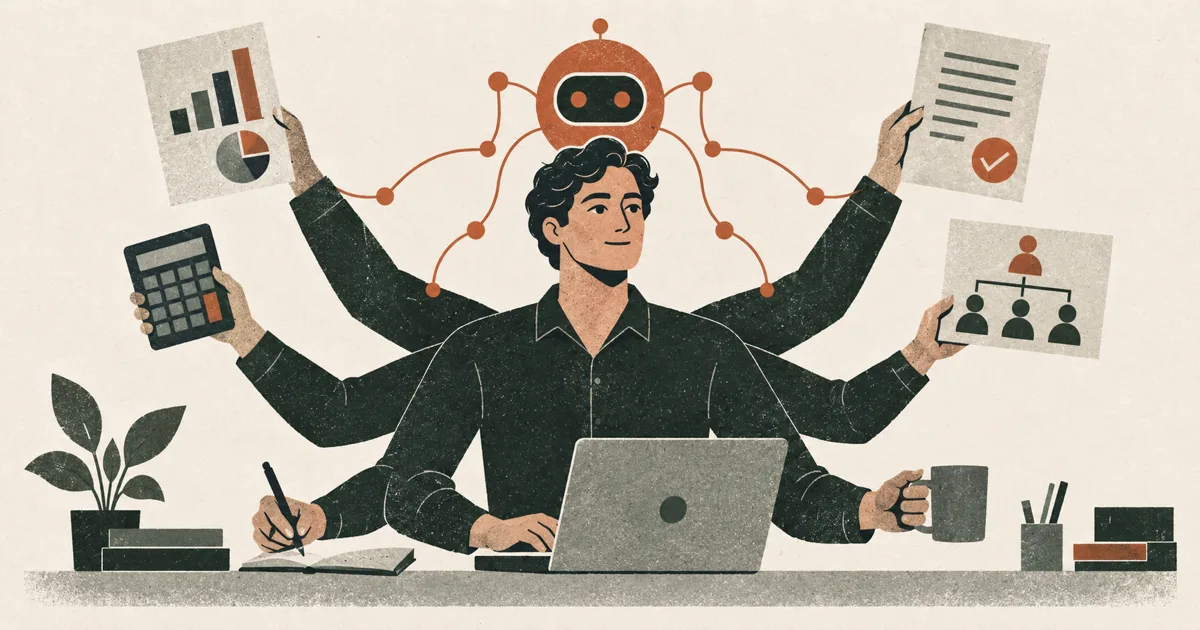
One person with AI delivers the quality of a team of two, and 16.8% of work requests to ChatGPT concern tasks from another profession. At the same time, the gain in judgment from working with AI goes to the experienced. We look at what this means for a small company.
Business has long handled complex tasks through specialization. A person is trained for years and then narrowed down: a finance professional becomes a finance professional in the mining sector, an HR officer becomes a recruiter or a payroll specialist. Teaching one person everything was too expensive.
With the arrival of AI, this logic is in question. If knowledge of an adjacent field is available in a minute, does a company need a separate lawyer, accountant, finance professional and HR officer? Or are three or four people with a broad profile enough?
We reviewed research from 2023-2026 and checked the key figures against the primary sources. The short answer: the boundaries between professions are blurring, and deep expertise is becoming more valuable and moving from execution to review.
People Already Take On Tasks From Adjacent Professions
In July 2026, OpenAI published the Work at the Frontier report. The researchers studied more than 800,000 work messages from ChatGPT users in the US and matched each one to the author's profession.
| Indicator | Value |
|---|---|
| Work messages about tasks from another profession | 16.8% |
| Same share among profession-specific messages | 43.5% |
| Share of "outside" tasks among designers | 35.2% |
| Workspaces with 2-5 seats | 18.9% |
| Workspaces with 101 or more seats | 16.3% |
In small companies there is more overlap. The authors' explanation is simple: there, the task goes to whoever is closest to it, because there is nobody to hand it to. The difference is modest and visible among ordinary users; among the most active users it disappears.
The second piece of evidence came from an experiment at Procter & Gamble (Dell'Acqua et al., 2025). It involved 776 specialists from R&D and the commercial function. One employee with AI delivered quality at the level of a team of two people working without AI, and spent 16.4% less time. Another result is more interesting. Without AI, engineers proposed technical solutions and commercial staff proposed commercial ones. With AI, the solutions became balanced regardless of the author's profile.
Who Benefits More From AI
In an experiment with 758 BCG consultants, participants with below-average results gained 43% in quality, and participants with above-average results gained 17%. In a customer support study of 5,172 employees, average productivity rose by 15%, noticeably more for newcomers. Both measurements were made on chat assistants from 2021-2023.
There is an important caveat. Chen and Bao (2026) gave 164 law students an exam in three variants: without AI, with AI, and with AI after brief training. Without training, strong students declined to use the tool, and the others wrote shorter answers and made more inaccuracies. After a ten-minute briefing the picture reversed: 41% of trained students used AI versus 26% of untrained ones, and their score was 0.27 points higher. The leveling effect comes from the combination of access plus training.
What Is Happening to Management
The coordination layer in large companies is getting thinner. Some of the decisions are directly tied to AI, and some run in parallel.
- •In September 2024, Amazon set a goal to raise the number of individual contributors per manager by at least 15% by the end of the first quarter of 2025. The stated reason is decision speed; the announcement does not mention AI.
- •At the end of 2024, Moderna merged its HR function and IT under one leader.
- •In April 2025, Shopify introduced a rule: before asking for new hires, a team shows why the task cannot be done with the help of AI.
- •In September 2025, McKinsey wrote that a team of two to five people already manages a "factory" of 50-100 AI agents.
At the same time, McKinsey describes three roles in the team of the future. A broad-profile generalist orchestrates the agents. A deep expert redesigns processes, handles exceptions and is responsible for quality. A frontline worker works with the client, supported by AI. In this scheme the generalist is one of three.
Where Depth Remains Decisive
Several studies show where the limit lies.
In the same BCG experiment (2023, GPT-4 model) there was a task beyond the AI capabilities of that time. On it, consultants with AI reached the correct answer 19 percentage points less often than colleagues without it: plausible text was convincing. The capability frontier has moved since then, but the mechanism remains.
In the first half of 2025, METR measured the work of 16 experienced developers on 246 tasks in large codebases. With the tools of that time they spent 19% more time, while estimating their own speed as 20% higher. A repeat measurement on late-2025 agents showed a speedup of 4-20%. The gap between perception and measurement remained: in 2026 surveys, developers report gains of 1.6x to 4x. Quality also needs an expert's eye: according to METR data from the end of 2025, of the AI solutions that passed automated tests, about half would be accepted in a real code review.
The most recent snapshot comes from the METR report for February-March 2026, prepared with the participation of Anthropic, Google, Meta and OpenAI. Agents at these companies already write complex code changes, analyze data and find vulnerabilities on their own. Humans retain the acceptance of changes to critical code, the framing of research tasks, hiring and budget decisions, and final judgments about risk. The authors' conclusion: in judgment and reliability, agents remain noticeably weaker than human experts, especially where the result is hard to verify quickly.
Autor et al. (2026) observed 133 patent lawyers at 11 US firms for three months. With AI, the quality of work rose, more for juniors. The lawyers were then tested on work without AI. Senior specialists' own judgment had strengthened, while juniors' average result stayed the same. Experience is amplified. The skill of verification is built on the very routine that AI now takes over.
Practice confirms this. In February 2024, Klarna reported that its AI assistant handles two thirds of customer support chats. In May 2025, the company returned people to complex requests for the sake of quality. In a Gartner survey of 321 customer service leaders, 20% reported headcount reductions because of AI.
Junior Specialists
Hiring for entry-level positions changes first. Hosseini and Lichtinger studied 62 million workers at 285,000 US firms: at companies that adopted generative AI, junior employment six quarters later is 8-10% lower than at the others. The cause is slower hiring; senior employment grows at the same pace as before.
Payroll data from ADP shows the same picture and sharpens it. According to Brynjolfsson, Chandar and Chen (August 2026 update), employment of workers aged 22-25 in the occupations most exposed to AI stands 19% below where it would be had it kept pace with less exposed occupations. Experienced workers show no comparable gap. The decline is concentrated where AI substitutes for human tasks. Where AI complements the worker, employment is flat or rising. A second detail: young workers lose ground in occupations built on codified knowledge, while in occupations that rely on tacit knowledge, employment of experienced workers grows faster. The authors describe these findings as early descriptive indicators; the paper makes no causal estimate. The OECD Employment Outlook 2026 reads the same evidence more cautiously: across Australia, Canada, the EU and the US, the role of AI in young people's labour market difficulties remains limited so far, and part of the effect may reflect that AI-exposed industries cut hiring first when money is expensive.
For a company this creates a task for years ahead. The expert who checks AI's work has to be grown, and the ordinary routine that used to serve this purpose is now less available. Training for juniors has to be designed separately.
What This Means for a Small Company
For small professional services firms there are few measurements so far. The most detailed snapshot is the 2026 Clio report on US law firms (a survey of 1,702 respondents). AI is used by 71% of solo lawyers and 75% of small firms. Revenue grew for roughly a third: 32% of solo lawyers and 31% of small firms, against 59% in firms with 200 or more employees. The reason is pricing: 86% of solo lawyers and 78% of small firms kept their billing model unchanged. The authors illustrate with an example: if a task with AI takes one hour instead of five, under hourly billing the client gets an 80% discount. For Kazakhstan there is a 2023 estimate from the Center for Workforce Development: 29% of work functions can be automated with high or moderate probability, and 13% can be performed by generative AI.
The research adds up to four practical conclusions.
- 1Each employee has breadth plus one real area of depth. One person runs a task end to end, across finance, taxes, HR and contracts.
- 2Every area with a high cost of error has an assigned owner. The owner checks the result and answers for it. The author of a result and its reviewer are different people.
- 3Working with AI is taught deliberately. Ten minutes of briefing in the Chen and Bao experiment delivered more than access to the tool alone.
- 4Juniors are developed on purpose: part of the tasks without AI, and a review of results together with a senior colleague.
How We Work With This at JB Solutions
We use automation where it can be verified. Bank statements from Kazakhstan banks are processed by deterministic parsers: the same statement always gives the same result. Allocation to categories and management reports are checked by a finance professional who answers for the figures to the owner. More on this in the article "AI Accountant in 2026".
If you are thinking about how to divide financial tasks between people and AI in your company, start with a diagnostic of your accounting. The free express diagnostic from JB Solutions shows the state of your reference data, month-end close and reporting, and which of these can be automated right now.
Sources
- •OpenAI: Work at the Frontier, July 27, 2026
- •Dell'Acqua et al.: The Cybernetic Teammate, NBER, 2025
- •Dell'Acqua et al.: Navigating the Jagged Technological Frontier, 2023
- •Brynjolfsson, Li, Raymond: Generative AI at Work, QJE 2025
- •Chen, Bao: Training for Technology, arXiv, 2026
- •Amazon: Andy Jassy's message, September 2024
- •WSJ: Why Moderna Merged Its Tech and HR Departments, May 13, 2025
- •CNBC: Shopify memo, April 7, 2025
- •McKinsey: The agentic organization, September 2025
- •METR: study of experienced developers, July 10, 2025
- •METR: Frontier Risk Report for February-March 2026, May 19, 2026
- •Autor et al.: Does AI Assistance Enhance or Erode Expertise, NBER, 2026
- •Klarna: press release on the AI assistant, February 27, 2024
- •CNBC: Klarna brings people back to support, May 14, 2025
- •Gartner: survey of customer service leaders, December 2, 2025
- •Hosseini, Lichtinger: Generative AI as Seniority-Biased Technological Change, 2025
- •Brynjolfsson, Chandar, Chen: Canaries in the Coal Mine, August 2026 update
- •OECD: Employment Outlook 2026, Chapter 1, July 2026
- •Clio: Legal Trends for Solo and Small Law Firms, 2026
- •Center for Workforce Development (Kazakhstan), 2023 estimate, via zakon.kz
Related service
Express Financial Diagnostics
An independent look at your finances in 5 days: 3-5 findings and a plan for what to fix first