AI and the Hiring of Young Professionals: What the Data Shows and What Economists Dispute
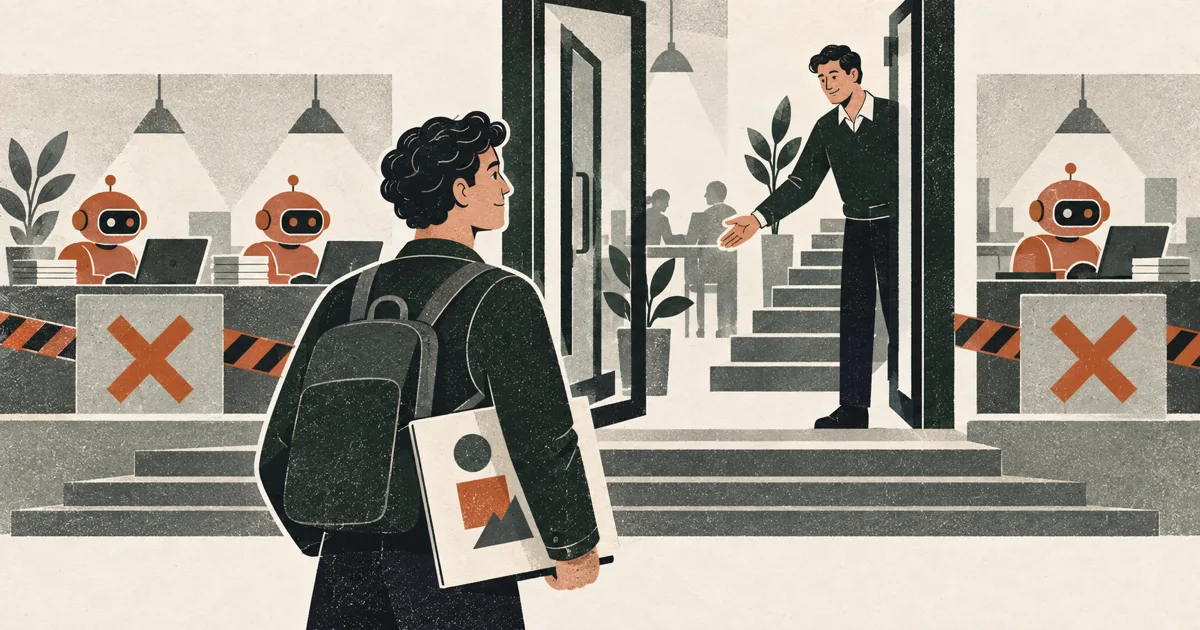
According to Stanford data, employment of workers aged 22-25 in AI-exposed occupations stands 19% below that of their peers in other occupations. The OECD considers the role of AI limited. We go through both positions.
The claim that AI is already taking jobs from the young has become familiar. Behind it stands one study that is updated every few months, and a dispute over how to read it.
What Stanford found
Erik Brynjolfsson, Bharat Chandar and Ruyu Chen work with ADP payroll data covering millions of US workers. The latest version of their paper Canaries in the Coal Mine came out in August 2026 and covers data through June 2026. The authors state six facts.
- 1Across the economy as a whole, there is no sign of widespread job displacement.
- 2Employment of workers aged 22-25 in the occupations most exposed to AI stands 19% below where it would be had it kept pace with their peers in less exposed occupations. Experienced workers show no comparable gap.
- 3The gap has widened steadily since August 2025.
- 4The mechanism is hiring: young workers are hired less often, while separations have not increased.
- 5The decline is concentrated where AI substitutes for human tasks. Where AI complements the worker, employment is flat or rising.
- 6Adjustment is occurring through the number of jobs; base compensation is unchanged.
In levels it looks like this.
| Occupation group | Employment of workers aged 22-25, November 2022 to June 2026 |
|---|---|
| The two most AI-exposed quintiles | about minus 11% |
| The three least exposed quintiles | about plus 10% |
One more observation: employment of young workers declines in occupations where knowledge is written down in rules and textbooks. In occupations that rely heavily on tacit knowledge, employment of experienced workers grows faster.
Why retellings quote different figures
Publications cite 13%, 16% and 19%. This is the same study at different points in time. The first versions gave an estimate adjusted for firm-level differences: 13% on July 2025 data and 16% on September 2025 data. In the latest version the authors switched to a simpler measure that requires no modeling choices: 19% as of June 2026. By the same measure, the figure for July 2025 was 15%.
Hosseini and Lichtinger reached a similar result on different data, covering 62 million workers and 285,000 US firms: at companies that adopted generative AI, junior employment six quarters later is 8-10% lower.
The OECD's objection
In July 2026 the OECD Employment Outlook came out, and its conclusion is more cautious.
- •Evidence on the effect of generative AI on the young is mixed and comes almost entirely from the US. Some studies find no effect.
- •AI-exposed occupations are concentrated in industries that depend heavily on the cost of money: information, finance and insurance, professional services. When conditions worsen, hiring there is cut first. From the outside this looks like an AI effect.
- •Data from Australia, Canada, the EU and the US suggest that the role of language models in youth unemployment remains limited.
- •The unemployment gap for graduates started to widen before the pandemic. No turning point is visible in any of the countries at the moment when firms took up language models at scale.
LinkedIn CEO Ryan Roslansky has voiced a similar position: according to the platform's data, the hiring rate for entry-level positions is down by roughly 12%, yet it is down just as much at all other levels, and the cause is general economic conditions.
The authors' reply
In the August 2026 version, the authors of Canaries respond to this objection. The gap persists when exposure to interest rates is taken into account and when technology firms and computer occupations are excluded. It kept widening through mid-2026, long after interest rates had peaked.
The authors also name the weak points themselves. Part of the divergence began before ChatGPT appeared. The effect weakens when education levels are taken into account. In national surveys it is less pronounced than in ADP data. They call their results early descriptive indicators and make no causal claim.
How to read this
The dispute is open, and each side has two independent sources. The accurate wording for today is this: in the US, in the occupations most exposed to AI, young people are being hired less, and the cause is disputed. No such data exist for other countries, Kazakhstan included.
Two takeaways are useful for a company whichever way the dispute ends.
- 1The way AI is applied matters. AI as an assistant to a professional goes with stable employment; AI as a replacement goes with reduced hiring.
- 2If fewer beginners are hired, where will experienced people come from in five years? Training for juniors has to be designed separately, with tasks on which judgment is built.
The overall picture is in our overview "AI and Narrow Specialization"; experience and training are covered in "Who Does AI Strengthen More".
Related service
Express Financial Diagnostics
An independent look at your finances in 5 days: 3-5 findings and a plan for what to fix first