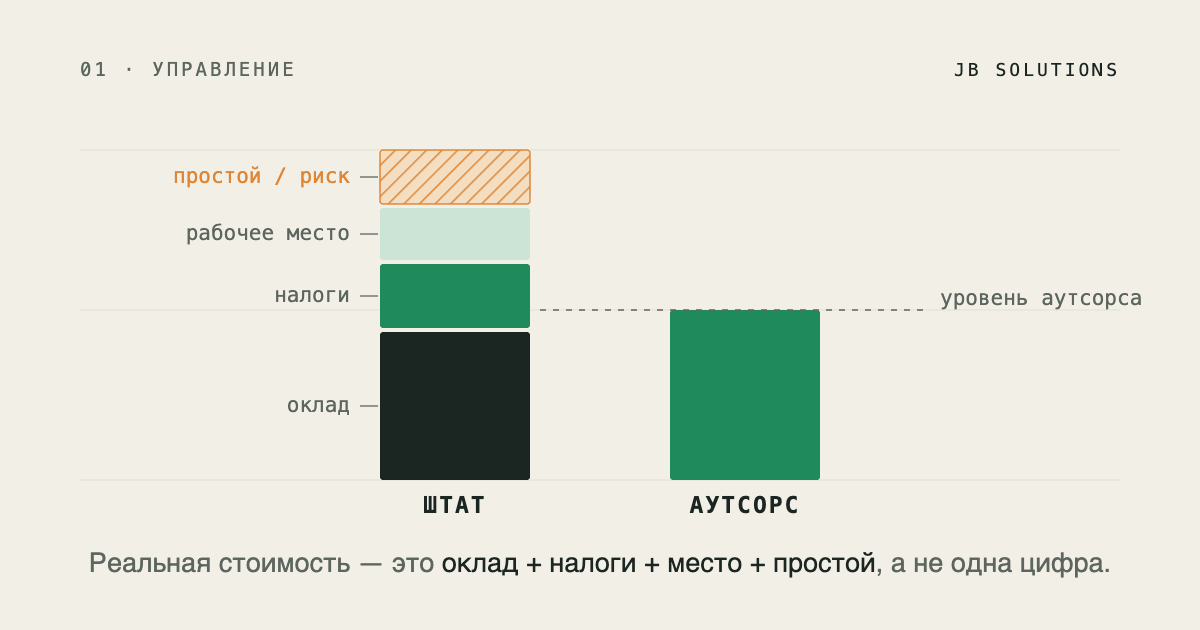
An in-house financier means more than just a salary. We calculate the true cost: taxes, workspace, and the risk of downtime.
Every entrepreneur faces the same decision sooner or later: hire an in-house financier or outsource the function entirely. At first glance it seems like there is no real difference, you pay money and receive a service. But when you calculate the true cost of a full-time specialist, the picture looks very different.
What an In-House Financier Actually Costs
Suppose you want to hire a financier with a net take-home salary of 500,000 tenge, the amount that lands on the employee's card. In reality, the company's total outlay is considerably higher.
To deliver 500,000 ₸ net, the gross (accrued) salary must be approximately 615,000 ₸. From this, the following are deducted: mandatory pension contributions (MPC) 10%; individual income tax (IIT) roughly 10% of the taxable base; and mandatory health insurance contributions (MHIC) 2%.
But the employer's costs do not stop there. On top of the accrued salary, the company pays directly from its own funds:
| Cost Item | Monthly Amount |
|---|---|
| Gross (accrued) salary | ~615,000 ₸ |
| Social tax (SN) 6% | ~32,500 ₸ |
| Social contributions (SC) 5% | ~27,700 ₸ |
| Employer health insurance contributions (EHIC) 3% | ~18,500 ₸ |
| Employer pension contributions (EPC) 3.5% | ~21,500 ₸ |
| Office space and utilities | ~80,000 ₸ |
| Equipment, software, 1C (depreciation) | ~40,000 ₸ |
| Office supplies and consumables | ~10,000 ₸ |
| Training and professional development | ~25,000 ₸ |
| Vacation pay and sick leave (prorated monthly) | ~50,000 ₸ |
| Total cost of in-house financier | ~920,000 ₸ |
And this excludes the cost of recruitment. If the specialist resigns, you will have to spend time and money all over again on sourcing, onboarding, and bringing someone up to speed on the specifics of your business. The process can take several months, during which the finance function sits idle or operates in a reduced capacity.
What Outsourcing Costs
With outsourcing you pay a single fixed fee that already covers everything: specialist salaries, their taxes, workstations, equipment, software, and training. No hidden costs.
But price is only part of the story. There are also fundamental differences in how the work itself is delivered.
Side-by-Side Comparison
| Parameter | In-House Financier | Outsourcing |
|---|---|---|
| Task setting | You define tasks and monitor execution yourself | Tasks are set by a senior partner at the outsourcing firm based on your business needs |
| Quality control | You must trust the specialist's competence, independent verification is difficult | The financier's work is reviewed by a more experienced senior specialist within the firm |
| Professional development | At your expense: courses, seminars, conferences | Included: the firm develops its own specialists |
| Replacing a specialist | A lengthy process: search, interviews, onboarding (1 to 3 months) | Quick replacement if the current specialist is not the right fit for any reason |
| Cross-industry experience | Limited to one person's background | The team works with clients across multiple industries, broader perspective and richer set of practices |
| Key-person risk | High: an employee's departure can paralyse the function | Low: knowledge of your business resides in the team, not in a single individual |
| Monthly cost | ~920,000 ₸ and above | Fixed fee, all-inclusive |
Conclusion
An in-house financier is not just a salary. It means taxes, office space, training, the risk of downtime when someone leaves, and the ongoing burden of overseeing quality yourself. Outsourcing removes all of these concerns: you receive a fully operational finance function with built-in quality control, continuous professional development, and the ability to replace a specialist quickly if needed.
For small and medium-sized businesses, outsourcing is the most practical way to access enterprise-level financial expertise without the corresponding overhead.
Related service
Fractional CFO
A CFO with a team for businesses that never had a finance function: we build finance from scratch and grow your permanent CFO