Shared Service Centers Are Changing Their Purpose: From Labor Savings to a Foundation for AI
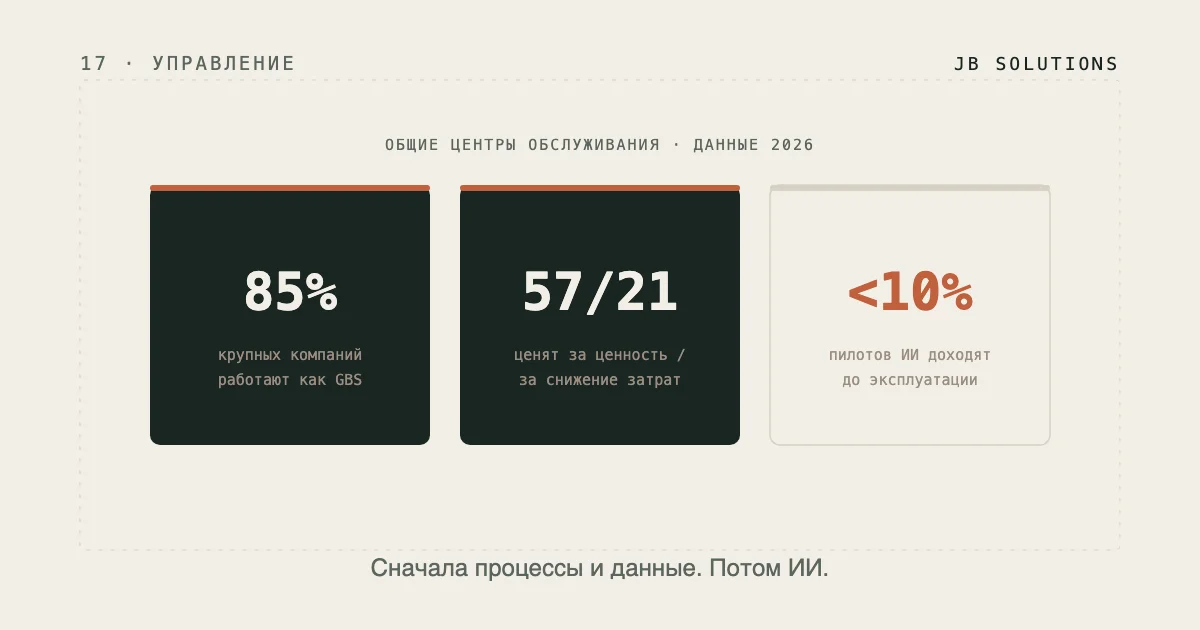
85% of large companies already run a shared services or GBS model. In 2026, centers are valued for the value they create, and AI delivers where processes and data are already consolidated. We review the latest SSON, Hackett, PwC and HFS research and five questions to ask about your own SSC.
By Bagdat Zhaxygeldin, founder of JB Solutions
The shared service center (SSC) was long a cost-saving tool. A large group pulled the accounting, HR, procurement and IT of its companies into a single unit, standardized processes and moved part of the work to where labor is cheaper. The model took hold: in 2026, 85% of large companies in the SSON sample already operate under the global business services (GBS) model or are moving to it [1].
What is changing in 2026 is the purpose of such a center. Industry reviews describe the next stage, in which the SSC becomes the place where a company deploys and governs AI. Companies that fail to make this shift risk being left with an expensive center built for the tasks of the previous decade.
Labor savings are no longer the main argument
In May 2026, PwC puts it directly: business services models that create value only by moving work to cheaper staff may already be insufficient for many companies [2].
This is also visible in expectations inside companies. SSON surveyed almost 500 business services leaders: 57% say internal customers value the SSC most for the value it creates, while 21% value it for cost reduction [1]. Centers are taking on work more complex than transactions: 55% manage master data for the whole company, and 45% provide analytics [1].
At the same time, the workload is growing. According to the Hackett Group's 2026 forecast, the volume of work in business services will grow by 15%, headcount by 10% and budget by 7% [3]. Hiring will not close this gap. It is closed by automation and AI.
AI works where processes and data are already consolidated
The main conclusion of the 2026 reviews concerns the order of actions. SSON calls AI adoption a test of operational discipline: AI quickly exposes fragmented processes and data [1]. At the SSON conference in autumn 2026, the head of Schindler's SSC put it this way: if you apply AI to a broken process, you get more problems. According to ScottMadden data cited at the same event, 30 to 50% of process work takes place outside formal systems [4].
HFS Research gives a telling example. As part of an internal program, IBM rebuilt processes in HR, IT, finance, procurement and other functions for approximately 270 thousand employees. The principle was: first remove unnecessary steps, then automate. According to the company, over three years the annual productivity savings reached 4.5 billion dollars against an initial target of 2 billion, and the operating costs of the HR function fell by 40% [5].
The SSC solves exactly this task: unified processes, unified data, one owner for each function. Savings used to justify centralization. Now it is the condition without which AI stays at the pilot level.
Pilots exist, results are still scarce
The picture is far from triumphant, though. According to HFS field research, fewer than 10% of AI pilot projects reach production [5]. Around a quarter of business services leaders plan broad AI deployment in 2026, compared with fewer than 10% a year earlier [3]. In the finance function, the share of companies using AI has almost stopped growing: 59% in 2025 versus 58% a year earlier. Gartner attributes the slowdown to complexity, data quality and a shortage of people [6].
McKinsey's October 5, 2026 review cites its own 2026 state of AI survey. 80% of respondents say AI has improved their individual productivity, yet only 37% report a positive EBIT impact, and just 6% qualify as AI high performers. Nearly three quarters of those high performers have substantially redesigned workflows, compared with a quarter of other organizations [8].
HFS also records a new risk for the centers themselves. In a number of large companies, functions have started taking work back from the SSC: they do not believe the center will deliver AI results fast enough [5]. Participants in the same discussion objected: a single function can automate its own part almost entirely, but exceptions and the hardest tasks live at the junctions between functions. If work is handed back to the verticals, nobody will cover this last stretch [5].
The takeaway for an executive: the SSC keeps its mandate only if it becomes a driving force of transformation itself. A center that merely services a flow of operations starts being taken apart piece by piece.
How the center itself is changing
- •Composition of work. 45% of leaders expect that within three years agentic AI will replace part of the work now done by employees of their own centers [1]. According to PwC's experience, AI agents can already perform 25 to 40% of the tasks companies usually hand over to business services [2]. This is a consultant's estimate, not survey data. At the same time, almost 80% of companies plan to expand the scope of their SSC in the coming year [1].
- •Headcount and structure. McKinsey partners expect business services to become 20-30% smaller while being markedly more productive. The staffing structure shifts from a pyramid with many operators to a "diamond": more mid-level specialists and new roles for people who manage a set of AI agents [7]. This is an expert estimate given in an interview.
- •Coordination roles. In McKinsey's project experience, roles that move decisions across the organization (project management, for example) have grown 1.5 to 2.0 times faster than line roles over the past five years. AI can remove part of that complexity, but a flatter structure pays off only if the lost coordination is replaced by better data, clear decision rights and strong human judgment [8].
- •People. 67% of companies are reviewing the value proposition for center employees [1]. Working with AI requires different skills, and there is competition for such people.
What this means in Kazakhstan
Large quasi-public and private sector companies in Kazakhstan built their SSCs on the classic model: HR, accounting and tax accounting, IT, procurement. The centers were created for savings and unified standards in groups of dozens of legal entities. There are few public results for them, and it is hard to judge from open data whether the declared effects were achieved.
For such companies, the question in 2026 sounds different: is the existing center ready to become a platform for AI? This means unified processes across the whole group, clean master data, process owners with real authority and control over the actions of AI agents. If the readiness is not there, the center faces the risk HFS writes about: functions will start taking work back and automating it on their own.
Five questions for your SSC
- 1What does the center exist for today? If the only metric is the cost of an operation, the center's mandate is under threat.
- 2Who owns the group's master data? Counterparty and item catalogs, the chart of accounts. Without a single owner, AI will multiply errors.
- 3Which processes run outside the systems? Email, spreadsheets, manual approvals. This part needs to be made visible and simplified before automation.
- 4How many AI pilots have reached production? If almost none, the problem is usually in processes and authority, not in the technology.
- 5Who is responsible for the actions of AI agents? Limits, thresholds, a decision log, a responsible person for each agent.
About the author and JB Solutions practice
Transformation and shared service centers. JB Solutions has experience in management transformation at large companies in Kazakhstan and Central Asia: in mining and metallurgy, oil and gas, railways, technology and telecom. We have built shared service centers and holding structures, distributed functions among the legal entities of groups, and rebuilt processes and organizational structures. More on the page Management and Consulting.
AI practice. For us, AI is a working tool that we apply in our own projects and implement for clients:
- •AI Readiness Assessment: a methodology for assessing a company's readiness for AI across seven dimensions, adapted to Law of the Republic of Kazakhstan No. 230-VIII, with the first Kazakhstani benchmark based on a survey of 17 industrial companies.
- •Courses for teams: AI Basics and Claude in Practice, where repetitive work turns into processes that run with a single line.
- •Ready-made JBS AI solutions for finance tasks.
If your SSC was built for savings and you want to understand whether it is ready to become a platform for AI, we start with a diagnostic: where the center creates value, which processes and data are ready for AI, and what to rebuild first.
Sources
- 1SSON Research & Analytics, We've Only Just Begun: What the Data Signals for the Next Era of Global Business Services, 15.01.2026 (based on the report State of the Shared Services & Outsourcing Industry 2026)
- 2PwC US, Agentic-first GBS: Moving beyond labor arbitrage, May 2026
- 3The Hackett Group, Study Finds GBS Leaders Betting on AI to Close Widening Productivity Gap (2026 GBS Key Issues Study), 24.03.2026
- 4SSON, Why Process Foundations Matter More Than AI in GBS Transformation, 06.10.2026
- 5HFS Research, GBS must own AI outcomes; here's how it can claim value, 09.09.2026
- 6Gartner, Gartner Survey Shows Finance AI Adoption Remains Steady in 2025, 18.11.2025
- 7McKinsey & Company, Agentic AI and the future of global business services (podcast), 11.08.2026
- 8McKinsey & Company, AI is changing work. Now it has to change the organization, McKinsey Quarterly, 05.10.2026
Related service
Business Processes
Process description and optimization: eliminate chaos, duplicates, and manual routine