Who Decides What in a Group of Companies: When It Is Time for the Owner to Delegate
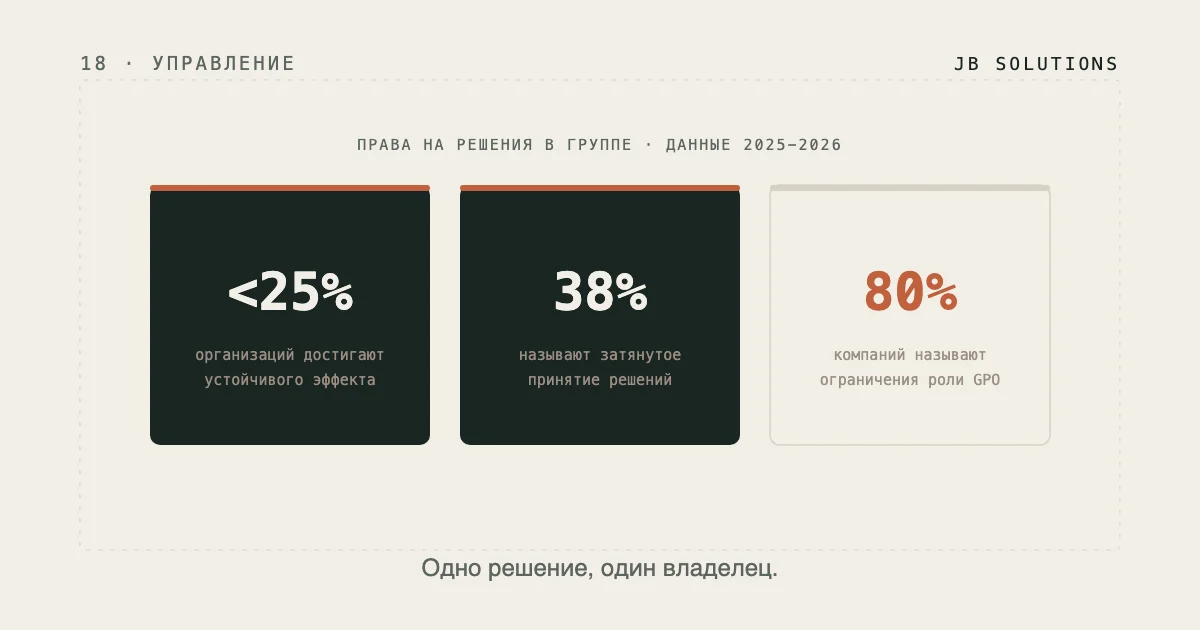
The company has grown into a group, yet every decision still runs through the owner. We review what 2025-2026 research by McKinsey, EY and Deloitte says about decision rights, what AI changes, and propose four pillars for running a group.
By Bagdat Zhaxygeldin, founder of JB Solutions
A business grows, and at some point one company turns into a group. A separate legal entity appears for a new line of business, then for a new region, then for a site or a large contract. Construction, mining, transport and trading holdings in Kazakhstan follow a similar path: the structure grows faster than the rules for managing it.
While the group is small, every decision converges on the owner. This works as long as the owner can keep up. When there are five, ten or fifteen companies, every decision raises the question: who makes it, the center or the company, and who is accountable for the result? If there is no written answer, the speed of the group is set by the throughput of one person.
What the research shows
Large companies have studied this problem for a long time, and the conclusions carry over to mid-sized groups.
McKinsey, in its State of Organizations 2026 report (a survey of more than 10 thousand executives, June and September 2025), writes that fewer than a quarter of organizations achieve a lasting effect from change. Among the obstacles to reallocating budgets and people, 38% of executives name slow decision-making [1].
The same report gives the example of one company where 35% of decisions were duplicated across functions, there were 60% more meetings than at comparable companies, and more than a thousand hours a month went into manual reporting [1]. This is a single case, but it shows well what blurred authority costs.
Something else is encouraging. When companies deliberately rebuild their operating model, results keep improving: in the 2025 McKinsey survey (2,000 executives, 16 industries), 63% of such projects achieved most of their goals, compared with 21% ten years ago [2]. Order in management is achievable if it is treated as a task in its own right.
A separate problem concerns the people entrusted with an end-to-end process: procurement, month-end close, settlements with suppliers across all companies in the group. EY, in a 2025 study (more than 250 participants), found that 80% of companies face at least one constraint on the role of such a process owner: insufficient reach, no authority over the budget, or no right to decide on systems. Half of the companies have no clear division of authority between those who run current operations and those who transform them [3]. HFS Research in September 2026 puts the same conclusion more briefly: there is accountability for the result, but no authority to deliver it [4].
How this looks in Kazakhstan groups
In recent years the country's largest holdings have written a clear principle into their corporate governance rules: the center is responsible for strategy, capital and control, while the group companies are responsible for operational management, including personnel, procurement and production. At the level of principle, the boundary is drawn.
In private groups that grew out of a single business, the picture is usually different. In our observation, it consists of several typical features:
- •The center is the owner and a small team around them. There is no formal management company, or it exists only on paper.
- •Each legal entity was created for its own task. Each has its own accounting, its own reference data and its own payment approval procedure.
- •The same functions are repeated in every company, and no one owns the process end to end.
- •Disputes between companies are resolved through the owner, because the rules on who decides are not written down anywhere.
It is too early for such a group to call in a large consulting firm and launch a large-scale transformation. It first needs to put in place the supports on which growth will rest.
What AI changes in structure and governance
AI adds another question to "who decides": who is accountable for decisions that a machine prepares or makes. McKinsey, in its State of Organizations 2026 report, names AI as one of three forces pushing companies to rethink how work, end-to-end processes and traditional structures are organized. At the same time, most organizations do not yet see a noticeable effect of AI on their financial results [1].
In the article "The agentic organization" (September 2025), McKinsey describes what this means for management [5]:
- •Structure shifts toward small teams that are responsible for an end-to-end result and themselves assign tasks to AI agents and supervise their work.
- •Control is built into the process. Checks, limits and an action log run continuously inside the process, instead of periodic paper-based reviews. Final accountability remains with a person.
- •The role of people changes: from executing operations to setting goals, choosing between options and being accountable for the outcome.
- •Planning and budgeting speed up, because an annual cycle cannot keep pace with processes where agents perform part of the work.
At the level of owners and boards of directors, the topic is only gaining weight. Deloitte, in a survey of 695 board members and executives (early 2025), found that for 31% AI is not yet on the board agenda, compared with 45% a year earlier. Two thirds of respondents say their boards have little or no knowledge and experience of AI [6].
McKinsey's October 5, 2026 review adds two observations about decision rights. First, coordinator roles, the ones that move decisions across the organization (project management, for example), have grown 1.5 to 2.0 times faster than line roles over the past five years. AI can remove part of that complexity, but a flatter structure pays off only if the lost coordination is replaced by better data, clear decision rights and strong human judgment. Second, an AI transformation needs an accountable leader who can move funding and scarce talent and resolve cross-enterprise trade-offs [7].
For a mid-sized group, four questions follow that are worth revisiting together with the decision map:
- 1Who owns the group's data. AI works on the data of all companies at once. If each legal entity has its own reference data, chart of accounts and reporting, the data has no owner, and any AI project will hit this first.
- 2Who is accountable for decisions that AI prepares. A payment proposed by an agent, a discount calculated by a model, a supplier selection by scoring: every such decision has a person who approves it and answers for the result.
- 3Who decides which AI tools to use. When employees of different group companies connect services on their own, the group's data ends up in third-party systems, and the rules are not written down anywhere. The decision on which tools to choose and what data may be passed to them is made by the center.
- 4How often the owner sees AI on the agenda. At least once a quarter: what has been implemented, what the effect is, what the risks are.
Four supports of group management
This is our position, based on the research above and on JB Solutions practice in projects on building holding structures, separating businesses and creating shared service centers.
- 1Decision map. For the group's key decisions (budget, large payments, hiring of executives, procurement, choice of systems, new projects), it is written down who proposes, who decides, who executes and who controls. One decision, one owner. The map fits on a few pages and takes most of the daily approvals off the owner.
- 2End-to-end process owners with authority. If the group wants unified accounting, unified procurement or a unified treasury, each such process has a person who is responsible for it across all companies and has the right to decide on rules, data and systems.
- 3Unified rules and data. A common chart of accounts, common reference lists of counterparties and items, an identical month-end close procedure, rules for the use of AI tools. Without this, group reporting is assembled by hand, and any ideas about automation and AI run into incompatible data.
- 4Management rhythm. Regular meetings with a clear agenda, a report by decision owners, and a clear procedure for who resolves a dispute between the center and a company, and within what time.
None of these supports requires a large program. They can be put in place within a few months, and they keep their value when the group has grown and the time comes for a major transformation.
Signs it is time
- •The owner personally approves payments and purchases in all companies of the group.
- •The same decision is discussed in two places, and the outcome depends on who got there first.
- •Each company has its own accounting and its own procedures, and consolidated reporting is assembled by hand over weeks.
- •New legal entities appear without a statement of what they decide on their own.
- •AI tools are connected by individual employees in individual companies, and the rules for using them are not written down anywhere.
- •Company executives say they are waiting for decisions from above, while the center says it is waiting for initiative from below.
If two or three items match, it is worth writing down authority in the group.
About the author and JB Solutions practice
Transformation and shared service centers. JB Solutions has experience of transforming management in large companies in Kazakhstan and Central Asia: in mining and metallurgy, oil and gas, railways, technology and telecom. We created shared service centers and holding structures, distributed functions among the legal entities of groups, and rebuilt processes and organizational structure. More on the page Management and Consulting.
AI practice. For us, AI is a working tool that we apply in our own projects and implement for clients:
- •AI Readiness Assessment: a methodology for assessing a company's readiness for AI across seven dimensions, adapted to the Law of the Republic of Kazakhstan No. 230-VIII, with the first Kazakhstan benchmark based on a survey of 17 industrial companies.
- •Courses for teams: AI Basics and Claude in Practice, where repetitive work is turned into processes that run with a single line.
- •Ready-made JBS AI solutions for finance tasks.
If your group has grown faster than the rules for managing it, we will start with a diagnostic: take two or three key processes, review who decides what in them today, and propose a decision map for the whole group.
Sources
- 1McKinsey & Company, The State of Organizations 2026, 19.02.2026
- 2McKinsey & Company, The new rules for getting your operating model redesign right, 25.06.2025
- 3EY, Transforming Enterprises: the strategic role of Global Process Owners, 2025
- 4HFS Research, GBS must own AI outcomes; here's how it can claim value, 09.09.2026
- 5McKinsey & Company, The agentic organization: Contours of the next paradigm for the AI era, 26.09.2025
- 6Deloitte Global Boardroom Program, Governance of AI: A critical imperative for today's boards, 2nd edition, 2025
- 7McKinsey & Company, AI is changing work. Now it has to change the organization, McKinsey Quarterly, 05.10.2026
Related service
Org Design
Organizational structure, roles, and accountability zones aligned with business goals