How AI Is Rebuilding Business Processes and What Companies Should Do: Global Practice and Kazakhstan
AI agents change the order of work itself, beyond the speed of individual steps. Using Gartner, McKinsey, Stanford and HFS data, we review which processes are rebuilt first, how an escalation model differs from an approval model, what holds most companies back, and how to act in Kazakhstan.
By Bagdat Zhaxygeldin, founder of JB Solutions
For decades, business processes were automated on one logic: take the existing way of working and run it faster. Electronic document flow sped up approvals, the accounting system sped up postings, a robot sped up data transfer. The process itself stayed the same: a chain of handoffs between functions, each with its own performer and its own control.
AI agents change the terms of the problem. They read a document in any format, work through an exception, prepare a decision and carry out the next step themselves, which makes it possible to rebuild the process itself. In its review of October 5, 2026, McKinsey names the redesign of the work itself as the sign of progress and separates it from speeding up the old model [1].
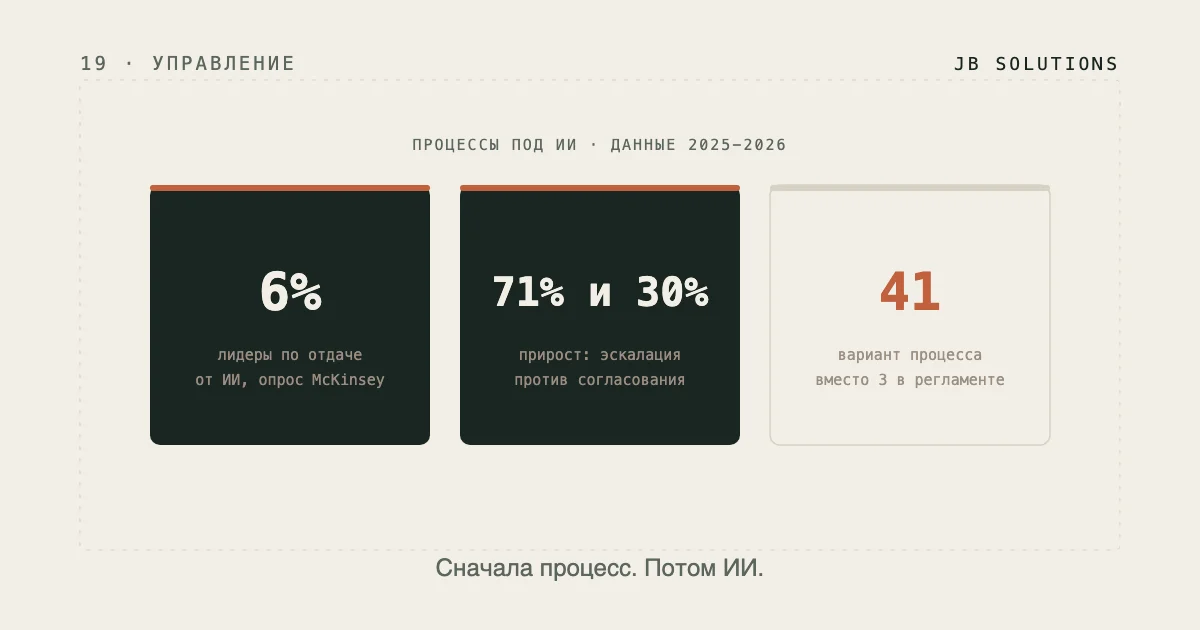
Tools are being adopted faster than processes are being redesigned. According to McKinsey, 80% of respondents report higher personal productivity from AI, but only 37% see a positive effect on EBIT, and the leaders in returns make up 6%. Almost three quarters of the leaders have substantially redesigned their workflows; among the rest, a quarter have [1]. Below we look at what exactly is being redesigned, how it works, what gets in the way, and what a company in Kazakhstan should do.
What is happening to processes worldwide
Which processes are redesigned first. According to a Gartner survey (183 finance leaders, May and June 2025), 59% of organizations use AI in finance. The most common uses are knowledge management (49% of adopters), accounts payable automation (37%), and detection of errors and anomalies (34%) [8]. The scope is wider: banks run part of their mortgage and compliance processes with "squads" of agents, at one global bank an "agent factory" runs client due diligence with ten such squads, insurers are rebuilding claims settlement, and telecom operators use agents in customer service [2].
How the structure of a process changes.
- •The process is designed from scratch. It is built "AI-first", and people and IT systems return to it selectively, where they are needed [2].
- •An agent handles the standard case, a person handles exceptions. Stanford compared models among successful deployments: under the escalation model (AI handles 80% or more on its own, people resolve exceptions) the median productivity gain was 71%, under the approval model (a person approves the AI's actions) 30%. The authors note that part of the difference may be explained by different tasks [4].
- •Control is built into the process. Controller agents challenge results and monitor policies, while final responsibility stays with a person [2]. Evaluation, monitoring, access rights, the degree of autonomy and the agent lifecycle become part of the operating model before launch [1].
- •Planning speeds up. The first companies are trying "agentic budgeting": agents propose budgets, scenario agents build forecasts, reporting agents deliver real-time figures [2].
- •Data may be imperfect, but it must be connected. Stanford concludes that messy data does not stop a project if the process is designed with it in mind. For many use cases the model is interchangeable, and the advantage comes from the orchestration layer [4].
How such processes are managed. An end-to-end outcome has an owner who is accountable for the goal, the economics and the constraints, and a small team with business, data, risk, compliance and cybersecurity expertise from day one. McKinsey calls this format a "mission factory": it redesigns work as a combination of people and agents, builds the controls, and leaves behind reusable components for the next outcome [1]. Above it sits an executive with the authority to reallocate funding and scarce specialists [1]. The organizational structure adapts to end-to-end processes (more in the article "Who Decides What in a Group of Companies").
In what order to act. According to HFS Research, IBM redesigned workflows in HR, IT, finance, procurement, sales and customer support for about 270 thousand employees: it first removed unnecessary steps and only then automated. According to the company's figures cited by HFS, annual savings over three years reached 4.5 billion dollars against a target of 2 billion [3].
What holds most companies back
Fewer than 10% of AI pilots reach production [3]. Gartner notes that 91% of finance organizations see low or moderate impact at the start, while those that have advanced are almost three times more likely to get a high one [8]. The Stanford Digital Economy Lab (April 2026, 51 successful deployments in 41 organizations across seven countries) found that 77% of the hardest problems were invisible costs: changes in how work is organized, data quality, rebuilding processes. 61% of successful projects were preceded by a failed attempt, and the common feature of those attempts is that AI was run as a technology project and applied to broken workflows [4]. The sample includes only successful cases. Lawyers, HR, risk and compliance resisted most often (35% of cases), so control functions should be brought into the project from day one [4].
Another reason: work is done differently from how it is written down. SSON cites a ScottMadden estimate under which 30 to 50% of process work is performed outside formal systems. We did not find the primary source, so treat this as an order of magnitude [5]. A published Dreher Consulting case shows the scale: at an equipment manufacturer with 320 employees there turned out to be 41 actual process variants instead of the three assumed, in 11% of orders production started without technical approval, and each such order lost 17 days on average. After a process owner and four metrics were appointed, cycle time fell by 23% in nine months. This is a single case, and the figures come from the company itself [6].
How to see the actual process and what to prepare before AI
From simple to complex:
- 1Follow one document from start to finish: a real order, contract or payment, whose path is reconstructed together with the participants.
- 2Review a sample of closed cases (for example, thirty orders) across email, spreadsheets and the system, including exceptions and returns.
- 3Ask those who work around the system what they do by hand because the system does not do it.
- 4Bring in system log analysis when the process is spread across several systems and repeats often. According to Dreher Consulting, it is justified with more than three systems, more than twenty process variants and at least 250 cases a month; otherwise a four-hour workshop is enough [6]. Such analysis sees only the steps that left a trace in a system.
Before handing a process to AI, five things are needed (our working framework, there is no single standard): a map of the actual process for at least one end-to-end case; an owner with the authority to make decisions on data and rules across all companies of the group; a list of exceptions stating who resolves each one and how; a common identifier that links an order, a contract and a payment across systems; three to five metrics (cycle time, rework rate, cost per operation).
What applies in Kazakhstan
In its 2026 study of Central Asia and the Caucasus, KPMG notes that companies in the region are adopting AI actively, but a noticeable share struggle to scale solutions and do not measure the effect (as retold by Digital Business) [7]. The picture matches the global one: pilots are launched faster than processes and metrics are built. In Kazakhstani groups of several legal entities, where each company has its own accounting base and its own reference data, the gap between the regulation and reality is usually the widest (our observation from practice, we found no direct studies).
Which processes to start with (our recommendation). The right candidates are processes with a large number of repeating operations, a clear share of exceptions, available data and a limited cost of error. For most mid-sized and large companies these are supplier settlements and the payment calendar, reconciliation of receivables and payables, processing of bank statements and source documents, period close and management reporting.
How to proceed (our position, following the logic of global examples at an achievable scale):
- 1Choose one or two processes and measure the baseline: cycle time, rework rate, cost per operation.
- 2Reconstruct the actual process and appoint an owner with the authority to change rules and data.
- 3Remove unnecessary steps and only then automate.
- 4Design the exceptions: what share the agent handles, what goes to a person, who decides and within what time.
- 5Build in control before launch: who approves the agent's actions, what limits it has, where the log is, which functions are involved from the start.
- 6Prepare the data: unified reference data and an identifier across legal entities and databases. If the group has a shared service center, it becomes the platform for this work (see "Shared Service Centers Change Their Purpose").
- 7Assemble a small team: a process owner, a process analyst, a data specialist, a control representative. Some roles can sensibly be filled by specialists engaged for the task (see "Expertise for the Task").
- 8After three to six months, measure the result and take the next process, using what remains after the first.
What we offer
We start with a diagnostic of one or two processes and take it through to a redesigned process that is ready for automation.
What we do. We study how the process runs today and document it (an as-is map with steps outside the systems and exceptions); we design the target model (to-be), removing bottlenecks and duplication; we lock the rules into regulations and a responsibility matrix; for AI we add a scheme of exceptions, controls and metrics, and an implementation plan with control points.
What we need from you. Access to one or two processes and to the people who perform them, system extracts for a sample of completed cases, and a responsible person on the company side with the authority to make decisions on the process.
What you get. The process map as it is, the target model, regulations, a responsibility matrix, a list of exceptions with owners, three to five metrics with baseline values, an implementation plan. After that the process can be handed to your own IT team or a contractor, and for finance tasks you can use ready-made JBS AI solutions.
Timing and cost. In our experience the work takes two to six weeks depending on the number of processes. We set the cost after the diagnostic. More on the service page "Business Processes".
Five questions for the executive
- 1Which two or three processes drive costs or speed the most, and who is responsible for each?
- 2How does the actual path of one document differ from the regulated one?
- 3What share of operations is standard, what share is exceptions, and who resolves the exceptions?
- 4By which three metrics will you know the redesign worked?
- 5Who in your group can change the rules and data of a process across all companies at once?
About the author and JB Solutions practice
Transformation and shared service centers. JB Solutions has experience of management transformation in large companies in Kazakhstan and Central Asia: in mining and metallurgy, oil and gas, railways, technology and telecom. We created shared service centers and holding structures, allocated functions between the legal entities of groups, and redesigned processes and organizational structure. More on the page Management and Consulting.
AI practice. For us AI is a working tool that we apply in our own projects and implement for clients:
- •AI Readiness Assessment: a methodology for assessing a company's readiness for AI across seven dimensions, adapted to the Law of the Republic of Kazakhstan No. 230-VIII, with the first Kazakhstani benchmark based on a survey of 17 industrial companies.
- •Courses for teams: AI Basics and Claude in Practice, where repetitive work is turned into processes that run from a single line.
- •Ready-made JBS AI solutions for finance tasks.
Sources
- 1McKinsey & Company, AI is changing work. Now it has to change the organization, McKinsey Quarterly, 05.10.2026
- 2McKinsey & Company, The agentic organization: Contours of the next paradigm for the AI era, 26.09.2025
- 3HFS Research, GBS must own AI outcomes; here's how it can claim value, 09.09.2026
- 4Stanford Digital Economy Lab (Pereira, Graylin, Brynjolfsson), The Enterprise AI Playbook: Lessons from 51 Successful Deployments, April 2026
- 5SSON, Why Process Foundations Matter More Than AI in GBS Transformation, 06.10.2026
- 6Dreher Consulting, Process mining in the Mittelstand: Method, Practice & Success, 22.05.2026 (updated 24.06.2026)
- 7Digital Business, reporting on the KPMG Caucasus and Central Asia Tech Report FY26, 28.05.2026
- 8Gartner, Gartner Survey Shows Finance AI Adoption Remains Steady in 2025, 18.11.2025
Related service
Business Processes
Process description and optimization: eliminate chaos, duplicates, and manual routine